
pH Level of Water: The 2026 Guide to Quality, Safety, and Environmental Balance
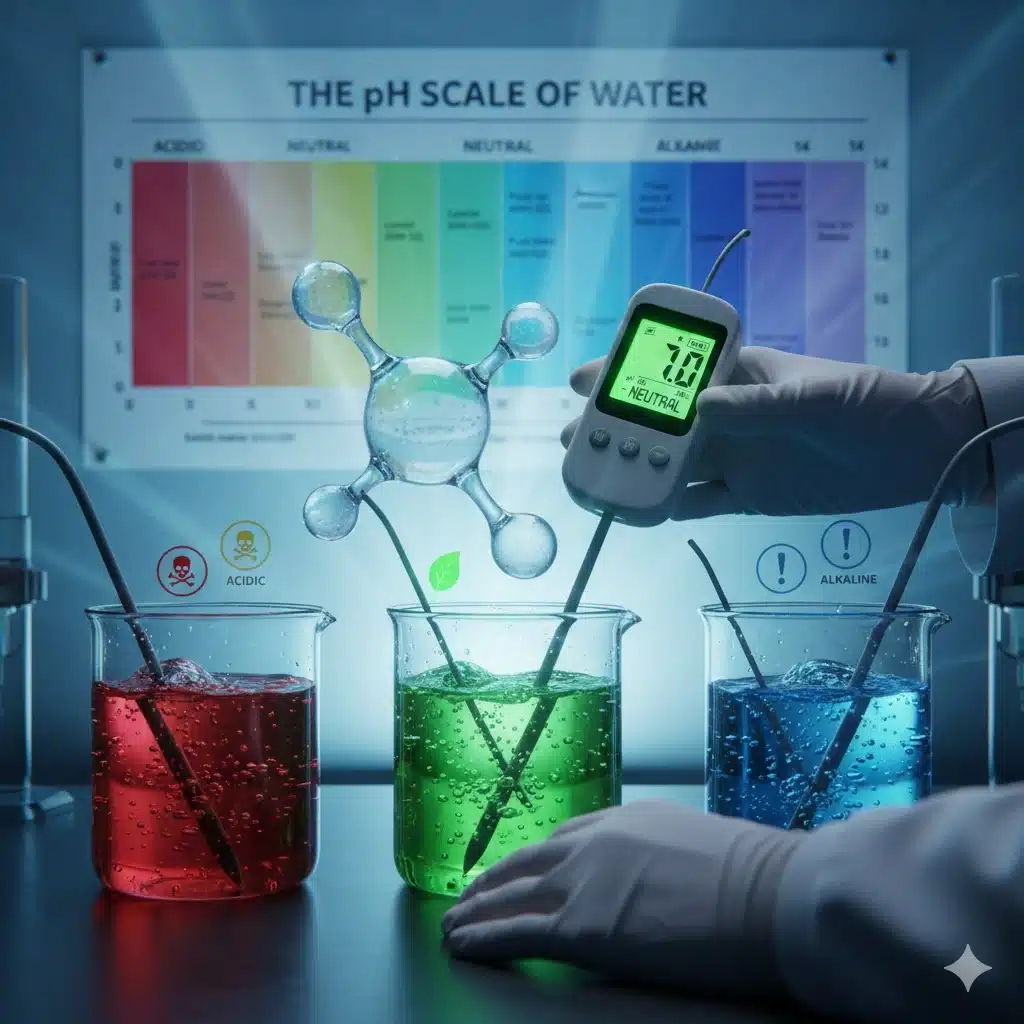
Water is the foundation of life, but not all water is created equal. Beyond clarity and taste, the pH level of water is the invisible metric that determines its safety, mineral balance, and environmental health. Measured on a logarithmic scale from 0 to 14, pH doesn’t just tell you if water is acidic or basic—it tells you how that water interacts with everything it touches, from your body’s cells to metal plumbing.
At a pH value of 7, water remains neutral. Acidity increases as the value falls below 7, while “basicity” or alkalinity develops when the value exceeds 7. Understanding the origins of these variations and the role of Total Alkalinity allows us to manage this precious resource effectively.
The pH Spectrum at a Glance

Sources That Determine the pH Level of Water
Natural occurrences and human-manufactured systems create the pH of water supply. Let’s explore these in detail.
| Natural Source | Effect on pH | Indicator |
|---|---|---|
| Rainwater (carbon dioxide) | Slightly acidic (≈5.6) | 🟡 |
| Acid rain (SO₂ & NOx) | Strong acidity | 🔴 |
| Groundwater (calcium & magnesium) | Higher pH | 🔵 |
| Rivers & lakes | Variable pH | 🟡 |
a. Natural Sources of pH Level of Water
Rainwater typically appears at a pH of approximately 5.6 because natural carbon dioxide (CO₂) transforms into weak carbonic acid. However, acid rain—caused by sulfur dioxide (CO₂) and nitrogen oxides (NOx)—can push this into dangerous levels of acidity.
Conversely, groundwater often moves toward higher pH levels. This is because minerals like calcium and magnesium are released from rocks and soil, acting as a natural buffer that raises the water’s alkalinity.
b. Human-Made Sources Affecting the pH Level of Water
Industrial wastewater, agricultural drainage, and domestic cleaning supplies prominently alter pH levels. While wastewater treatment facilities aim to neutralize output, the release of fertilizers and pesticides can cause significant fluctuations in local water bodies.
Why Water pH Fluctuates: Natural & Human Drivers in the pH Level of Water
| Natural Process | pH Change | Indicator |
|---|---|---|
| Photosynthesis (daytime) | Raises pH | 🔵 |
| Respiration (night) | Lowers pH | 🔴 |
| Seasonal temperature changes | Variable | 🟡 |
The pH values of water alter due to multiple elements. Environmental stimuli together with human-made production form the basis for pH changes in water samples.
a. Natural Processes Influencing pH Level of Water
Photosynthesis & Respiration: During the day, aquatic plants absorb CO₂for photosynthesis, which reduces acidity and raises pH. At night, respiration releases CO₂ back into the water, lowering the pH.
b. Human Activities Changing the pH Level of Water
Mining & Construction: Mining operations often trigger the release of hydrous sulfide minerals, creating sulfuric acid (H₂SO₄) which crashes pH levels.
Urban Runoff: Non-permeable surfaces like concrete prevent natural filtration, leading to high-pollution runoff that destabilizes the local water chemistry.
| Activity | Resulting Effect | Indicator |
|---|---|---|
| Mining operations | Sulfuric acid formation |  |
| Fertilizer runoff | Algal blooms & pH rise |  |
| Urban development | Increased pollution |  |
The "Optimal Zone": Advantages of pH Level of Water
The water quality improves greatly when its pH remains within the proper range. We should explore these multiple advantages.
| Benefit | Impact | Indicator |
|---|---|---|
| Safe pH range (6.5–8.5) | Healthy consumption |  |
| Reduced pipe corrosion | Less metal leaching | |
| Effective disinfection | Better chlorine action | |
a. Importance of pH Level of Water for Drinking
Human Health & Infrastructure: Water in this range is less likely to corrode metal pipes. This prevents the leaching of hazardous heavy metals like lead and copper into your drinking water.
b. Role of pH Level of Water in Aquatic Ecosystems
| Advantage | Outcome | Indicator |
|---|---|---|
| Stable pH (6.5–9.0) | Biodiversity growth | 🟢 |
| Healthy reproduction | Species survival | 🟢 |
| Reduced metal toxicity | Safer habitats | 🟢 |
A stable pH supports biodiversity. Almost all aquatic organisms reach their peak growth rate within the pH range of 6.5 to 9.0. Great ranges of pH levels serve as essential requirements for fishes, insects along with plants in order to thrive and reproduce and grow adequately. A pH balance reduces the likelihood that dangerous substances such as aluminum from sediment will release into the water to create harm for aquatic animals.
c. Benefits of Proper pH Level of Water for Agriculture and Industry
An appropriate water pH level helps industrial processes together with agricultural operations work optimally. Manufacturing facilities require particular pH values to carry out their cooling tasks and waste treatment operations along with various other industrial processes. Companies in the agricultural sector use water with neutral pH to optimize soil conditions that improve both nutrient levels and crop development.
| Sector | Benefit | Indicator |
|---|---|---|
| Agriculture | Improved soil & crops | 🟢 |
| Industry | Efficient cooling & treatment | 🟢 |
| Equipment | Longer lifespan | 🟢 |
Disadvantages of Imbalanced pH in Water
Acidic Water (<6.5): Causes pipe corrosion, resulting in high repair costs and health risks to the nervous system and kidneys due to metal leaching.
Alkaline Water (>8.5): Leads to “scaling” in pipes, which reduces water flow. It can also cause a bitter taste, skin inflammation, and reduced disinfectant power.
Environmental Collapse: Extreme pH levels can cause ammonia toxicity (in high pH) or damage fish gills (in low pH), leading to massive die-offs in aquatic ecosystems.
a. Effects of Acidic pH Level of Water
Water which has a pH level below 6.5 eats away at metal pipes thus creating opportunities for destructive substances including lead and copper to leak into drinking water. Acidic water conditions lead to health dangers which affect the nervous system and kidney organs. The acid levels in water harm plumbing systems thus resulting in extensive maintenance expenses.
| Problem | Consequence | Indicator |
|---|---|---|
| Pipe corrosion | Lead & copper release | 🔴 |
| Health risks | Kidney & nerve damage | 🔴 |
| Infrastructure damage | High repair costs | 🔴 |
b. Problems Caused by Alkaline pH Level of Water
| Issue | Impact | Indicator |
|---|---|---|
| Pipe scaling | Reduced water flow | 🔴 |
| Bitter taste | Poor water quality | 🔴 |
| Skin & digestive issues | Discomfort | 🔴 |
Water having a pH value above 8.5 causes pipe scaling that leads to lower water flow and decreased operational efficiency of appliances. Strong alkaline water creates bitter tastes in drinking fluids while lowering the power of disinfectants. Highly basic water can generate intestinal discomforts while leading to skin inflammation in particular scenarios.
c. Impact of Abnormal pH Level of Water on Aquatic Life
A deviating water pH level from its normal range creates catastrophic consequences for all parts of aquatic environments. The acidic condition of the water damages fish and amphibian gills while preventing them from extracting oxygen.
Water pH levels that decrease can result in diminished reproduction rates of different species which eventually leads to their extinction. Exposure to alkaline water leads to ammonia toxicity resulting in instant death of fish and aquatic organisms.
| pH Condition | Effect | Indicator |
|---|---|---|
| Low pH | Gill damage & oxygen loss | 🔴 |
| Reduced reproduction | Population decline | 🔴 |
| High pH | Ammonia toxicity | 🔴 |
Managing and Maintaining the pH Level of Water
| Method | Purpose | Indicator |
|---|---|---|
| Regular pH testing | Early detection | 🟢 |
| Lime or CO₂ treatment | pH correction | 🟢 |
| Agricultural buffer strips | Reduced runoff | 🟢 |
| Public awareness & policy | Long-term protection | 🟢 |
Proper pH management needs active monitoring followed by appropriate interventions. Here’s how we can achieve it.
Monitoring and Testing
Measuring pH levels frequently helps both the detection and monitoring process. The water treatment process requires either carbon dioxide or lime addition to achieve proper pH correction. Buffer strip and controlled fertilizing applications constitute the corrective actions that minimize runoff-related pH value alterations in agricultural settings.
The promotion of resource preservation and sewerage waste management policies requires government support together with industrial participation. The understanding of water pH value importance by society members will lead to responsible water resource protection.
The pH value in water stands as an essential indicator because it shapes the condition of ecological systems as well as manufacturing operations and human wellness. The distribution of information about sustainable pH monitoring practices along with the development of safe potable water is essential for the community and its stakeholders.
Life depends on water so balancing its conditions stands as the primary objective. The defined targets show a possible path to sustainable water management.
Frequently Asked Questions (FAQ)
Q: Is it safe to drink water with a pH of 9.5?
A: Generally, yes. Many bottled “alkaline waters” sit in this range. However, for daily tap water, the EPA recommends a limit of 8.5 to prevent mineral buildup and digestive discomfort.
Q: Does boiling water change its pH?
A: Yes. Boiling removes dissolved CO₂, which is acidic. As the CO₂ escapes as steam, the water typically becomes slightly more alkaline.
Q: Why does my water taste like metal?
A: This is often a sign of low pH (acidic water). The acid is likely eating away at your copper or iron pipes, “leaching” the metal directly into your glass.


No comment